
First Responders and the People Who Love Them
The call ended hours ago. You are home, on the couch, technically. Your partner is telling you about their day and you are nodding in the right places and you are not there.
Turning it off was never the skill. Turning it off is the problem wearing a uniform. What kept you functional on the worst scene of the month is the same thing sitting between you and your family at dinner.
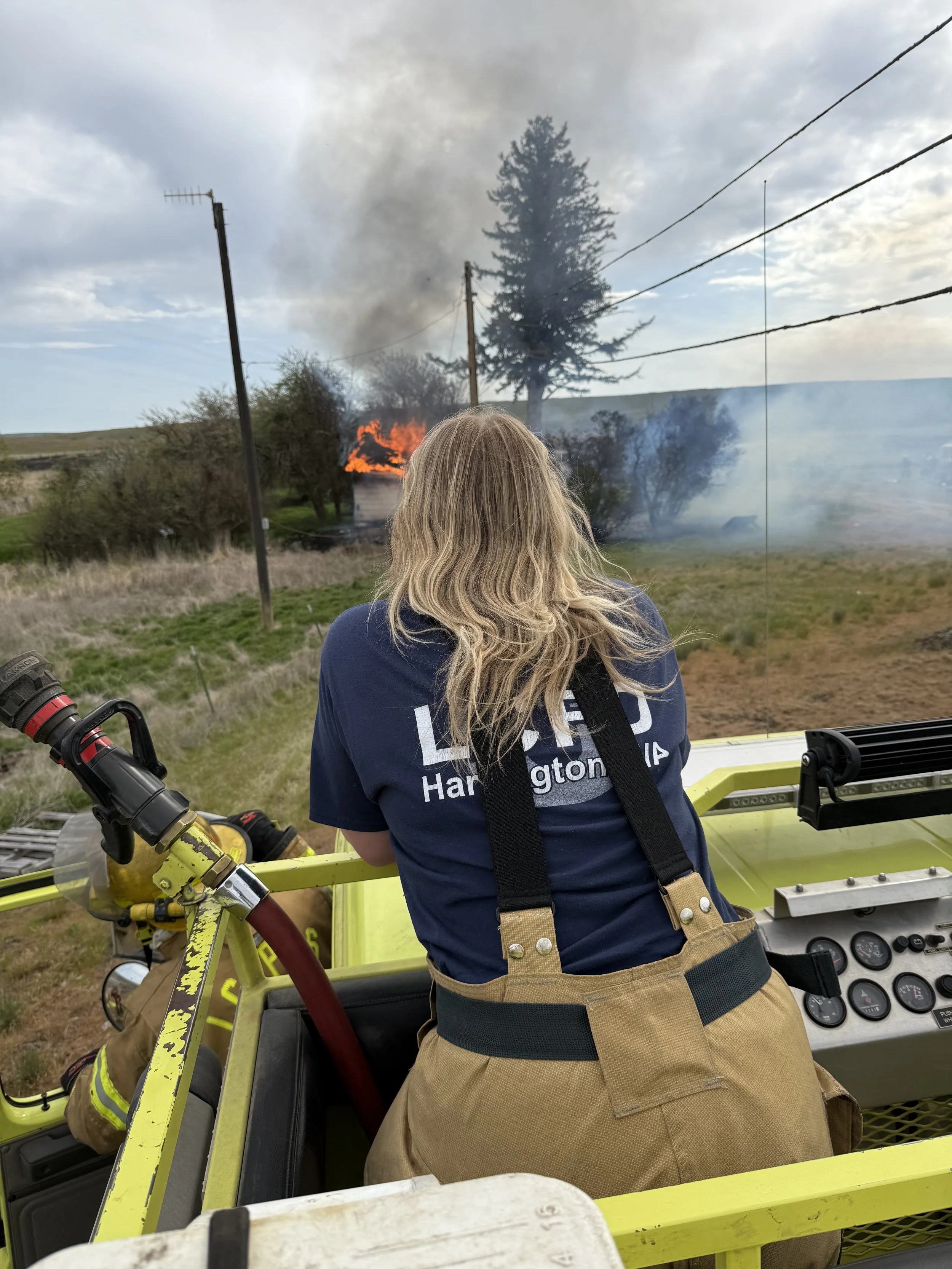
I am not guessing about this. I am a volunteer firefighter and EMT, and I have been the one on the couch.
Whitney Baker, LMFTA. Thirteen years in mental health and social services, Gottman-trained, with additional training in therapy for first responders and their families.
Who this is for
Fire, law enforcement, EMS, dispatch, corrections. Career and volunteer. And the people at home, who are running their own version of the job.
If you run the calls
Hypervigilance that does not switch off in your own driveway. Sleep that never fully resets. The thing you saw in March that you have not said out loud to anyone.
Going quiet at home, because the alternative is saying something you cannot unsay, and because nobody there is going to understand it anyway.
Drinking a little more than you used to. Snapping at people who did not earn it. Feeling most like yourself at the station and least like yourself at home, and knowing exactly how that sounds.
If you love someone who does
You track the scanner. You read the mood before the door closes. You have gotten very good at holding a household together around a schedule nobody else's family has.
You manage their stress, their silence, their bad days, and you do most of it alone, because who exactly would you tell.
Secondary trauma is real and it does not get talked about enough. You are not just the spouse. You are carrying your own weight in this.
You can come separately or together. Plenty of couples start with one person and add the other later, and plenty never do. Both work.
Not your department. Not your EAP.
I am a completely independent private practice. No affiliation with any police, fire, or emergency management agency. Your department will not know you are here.
How this differs from EAP
Employee assistance programs typically cap you at three to six sessions and are tied to your employer. This is ongoing for as long as it is useful, fully confidential from your department, and specialized in first responder work rather than generalist.
What about your job
Therapy content is confidential. I do not report to your employer and I cannot be required to hand your sessions to them. The only exceptions are the legal ones that apply to every therapist: imminent risk of harm to yourself or someone else, suspected abuse of a child or vulnerable adult, or a court order.
Insurance and records
Private pay means no diagnosis on file with an insurer and no claims record. For a lot of my clients, that is the entire reason they chose it.
Fitness for duty
I am not a fitness for duty evaluator and I do not perform those assessments. If your department requires one, that is a different clinician doing a different job, and I will tell you so plainly.
What the work looks like
We start with what the job has trained into you, because most of it was correct. Flat affect on scene is not a character defect, it is the reason you are useful at three in the morning. The problem is that it does not come with an off switch, and nobody ever taught you how to build one.
So we build one.
- Coming down after a call instead of staying at eight out of ten for two days
- Being reachable at home without having to explain the job to get there
- Saying the hard thing to your partner in a way that does not turn into a debrief or a fight
- Sleep, when the shift schedule is what it is
- Handling the calls that stuck, on your own timeline, not on a schedule someone else set
- Figuring out what you and your partner actually need from each other now, which is usually not what you needed five years ago
If you are a couple, this is couples work with someone who does not need the job explained. If you are coming alone, it is individual work, and your partner does not need to be involved.
Scheduling around shift work
Early morning appointments exist on this schedule specifically because coming off a night shift is a real thing and a nine to five therapist cannot help you. Evenings are available too.
Tell me your rotation and I will tell you what I have.
What it costs
Session rates
$170 for 50 minutes, individual or couples. $200 for extended couples sessions up to 90 minutes.
Private pay, out of network for insurance, superbill provided after every session. Full rates and reimbursement details.
Online across Washington and Idaho, which means you can do this from home, from the station on a slow shift, or from your truck in a parking lot. All three happen.